

You are using an out of date browser. It may not display this or other websites correctly.
You should upgrade or use an alternative browser.
You should upgrade or use an alternative browser.
Shinigami Files
- Thread starter admins
- Start date

Nobody
Member

GhoulBunny
Member
Attachments



KagiSenkō
Member





Osamu Shimazu
New member
━━━━━━━━━━━━━━━━━━━━━━━━━━━━━━━━━━━━━━━━
GOTEI 13 PERSONNEL ARCHIVE
OSAMU SHIMAZU
Third Division Fourth Seat • Heir of House Shimazu
━━━━━━━━━━━━━━━━━━━━━━━━━━━━━━━━━━━━━━━━
Ⅰ. PERSONNEL RECORD
─────── ◇ ───────
“A seat determines my responsibilities. Whether I justify them is a separate question.”
Character Name: Osamu Shimazu
Titles & Aliases: Heir of House Shimazu
Actual Age: 23
Apparent Age: Early Twenties
Birthday: October 9th
Origin: Soul Born
Race: Shinigami
Gender: Male
Height: 185 cm, 6’1”
Weight: 73 kg, 161 lbs
Allegiance: Gotei 13, Third Division, House Shimazu
Division: Third Division
Previous Divisions: None
Rank: Fourth Seat
Position: Third Division Fourth Seat, Shin’ō Academy Instructor
Base of Operations: Third Division Barracks, Shin’ō Academy, Shimazu Estate
Ⅱ. PHYSICAL DESCRIPTION
─────── ◇ ───────
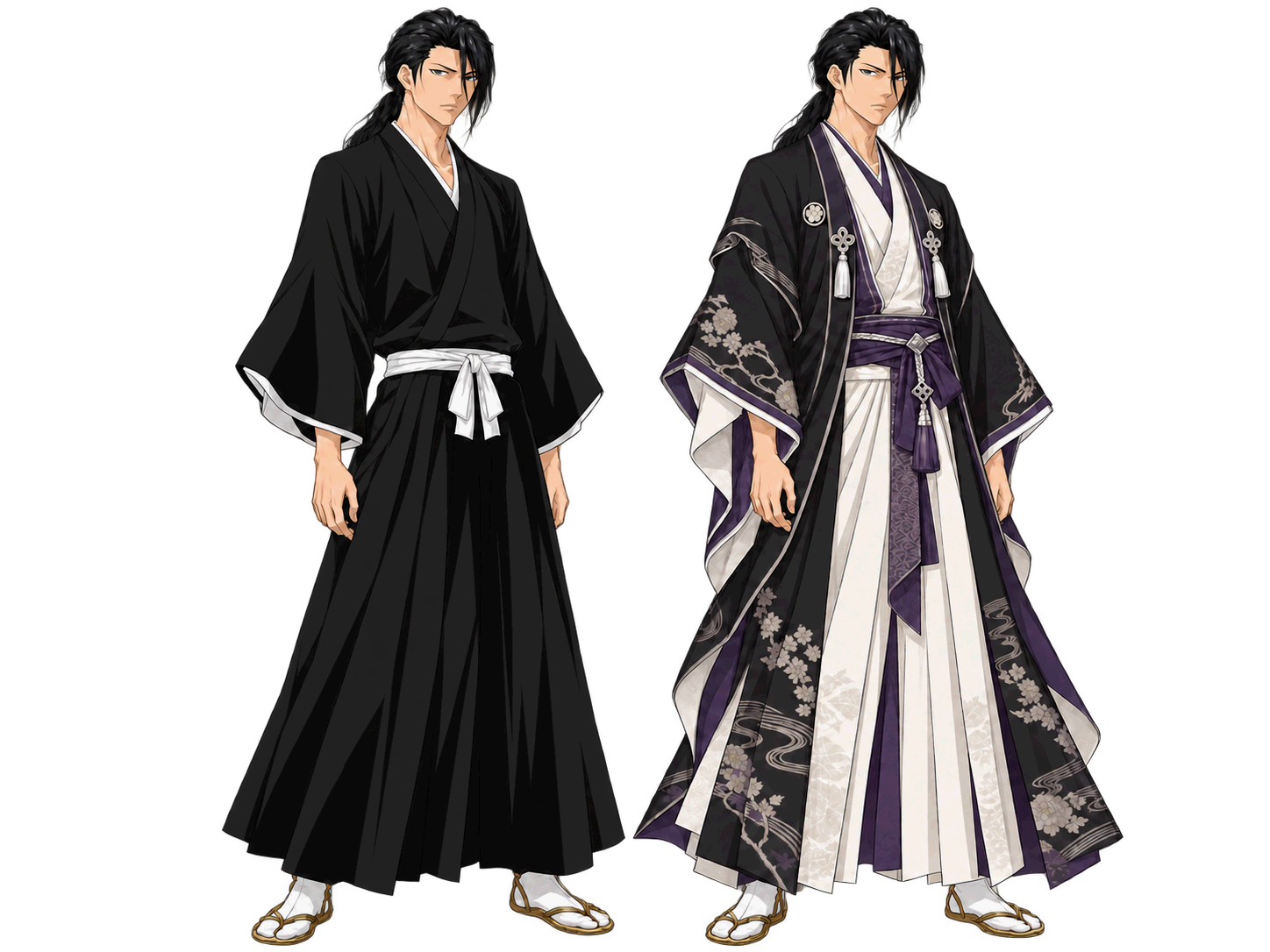
“House Shimazu owns considerably finer clothing than this. Fortunately, none of it improves footwork.”
─────── ◇ ───────
“House Shimazu owns considerably finer clothing than this. Fortunately, none of it improves footwork.”
Osamu is tall and lean, with long limbs, a narrow waist, an angular face, and dark eyes that tend to remain fixed on whatever has caught his attention. His black hair falls beyond his shoulders and is normally secured low with a plain white cord, although training and prolonged fieldwork tend to pull several strands loose around his face. His features are severe without being physically imposing, and his naturally controlled posture often makes him appear slightly taller than he actually is.
His body is conditioned for precision rather than exceptional physical strength. Years of Zanjutsu, Hakuda, Hohō, and deliberate work on balance have left him wiry and well trained, with callused hands and the compact musculature expected of someone who has spent much of his life handling a sword. His hands rarely drift without purpose, and his feet naturally settle into positions from which another movement can follow.
Since acquiring his Asauchi, Osamu ordinarily wears two standard-length katana at his left hip, arranged so neither interferes with the other’s draw. Kyōmon remains the visually distinctive blade, carried in its white lacquered saya with a deep-violet cord, restrained silver fittings, four-window rectangular guard, and a single framed mirror charm. The Asauchi is deliberately plain: a dark charcoal-black lacquered saya, black hilt wrap over pale samegawa, black cord, restrained silver fittings, and a solid rectangular silver-gray guard. One sword carries an established identity and inherited history; the other still looks like the unclaimed vessel it is.
On duty he wears a conventional Shihakushō without a rank armband or any special alterations intended to advertise his seat or noble status. At the Shimazu estate he favors layered black, ivory, muted lavender, and deep violet clothing with restrained silver fittings. House Shimazu could dress its heir considerably more extravagantly, but Osamu generally considers ornament worthwhile only when ceremony actually calls for it.
When Kyōgan is active, the most obvious physical change appears in his eyes. His irises deepen toward reflective black-violet while two narrow frame-like markings become visible around each pupil. Light can appear fractionally displaced across their surfaces, giving his gaze the appearance of polished mirrors reflecting something from an angle slightly different from the one at which he is actually looking.
Ⅲ. PERSONALITY
─────── ◇ ───────
“You are welcome to disagree with me. I only ask that you bring a reason worth disagreeing over.”
─────── ◇ ───────
“You are welcome to disagree with me. I only ask that you bring a reason worth disagreeing over.”
Osamu grew up among people who often understood the weight of his surname before they knew anything about him. House Shimazu gave him excellent private teachers, extensive archives, financial security, political connections, and opportunities many Souls would never receive. He has never been interested in pretending otherwise. What irritates him is the assumption that access to those advantages settled the question of what he later earned for himself.
The result is a particular kind of pride. Osamu is formal, observant, exacting, stubborn, and frequently arrogant, especially on subjects he has studied carefully. A precise correction usually interests him more than it offends him; being shown exactly where his reasoning failed can earn more respect than agreement ever would. Seniority, reputation, and tradition fare much worse when they are offered in place of an explanation.
Osamu understands military hierarchy and will obey a lawful order even when he disagrees with it. What changes is the respect behind that obedience. Officers who understand the consequences of their decisions and accept responsibility for them can earn fierce loyalty from him; officers who rely entirely on rank will receive the obedience their office requires and very little more.
He has spent much of his life asking why established techniques work instead of stopping at the fact that they do. More than once, he has stripped away something he considered inefficient and discovered through failure that the supposedly unnecessary piece had been carrying part of the structure. Those mistakes cured him of novelty for novelty’s sake. He still experiments aggressively, but he wants to understand a tradition before deciding he can improve it.
His behavior as an instructor reflects the same philosophy. Osamu notices small technical errors quickly and dislikes allowing students to repeat them until they become habits. He changes distance, partners, terrain, timing, and pressure until a student demonstrates that they understand why a technique works rather than merely reproducing its outward shape. His instruction can be severe, but he has little respect for teachers who use humiliation as evidence of rigor or inflict needless injury merely because students occupy a lower position in the hierarchy.
Osamu is deeply protective of people he considers his responsibility, and that instinct has an ugly edge when he is frightened for someone. He can slide from helping into deciding what risks another person should be allowed to take. His oldest friends learned the habit at the Academy and have spent years reminding him, usually without much ceremony, that concern is not ownership.
His anger is generally quiet. He becomes more deliberate rather than louder, and the precision of his language tends to increase as his patience decreases. Around people he trusts, much of that severity relaxes into dry humor, competition, and a willingness to argue about relatively trivial matters with considerably more enthusiasm than he would usually admit.
Appointment as Fourth Seat has not made Osamu feel finished. If anything, it has given him responsibilities he intends to justify through service. Captaincy remains a distant possibility he takes seriously, but the vacant office at the head of Third Division does not feel like an inheritance waiting to be collected. For now, he is more concerned with proving the judgment behind his current appointment sound.
The result is a particular kind of pride. Osamu is formal, observant, exacting, stubborn, and frequently arrogant, especially on subjects he has studied carefully. A precise correction usually interests him more than it offends him; being shown exactly where his reasoning failed can earn more respect than agreement ever would. Seniority, reputation, and tradition fare much worse when they are offered in place of an explanation.
Osamu understands military hierarchy and will obey a lawful order even when he disagrees with it. What changes is the respect behind that obedience. Officers who understand the consequences of their decisions and accept responsibility for them can earn fierce loyalty from him; officers who rely entirely on rank will receive the obedience their office requires and very little more.
He has spent much of his life asking why established techniques work instead of stopping at the fact that they do. More than once, he has stripped away something he considered inefficient and discovered through failure that the supposedly unnecessary piece had been carrying part of the structure. Those mistakes cured him of novelty for novelty’s sake. He still experiments aggressively, but he wants to understand a tradition before deciding he can improve it.
His behavior as an instructor reflects the same philosophy. Osamu notices small technical errors quickly and dislikes allowing students to repeat them until they become habits. He changes distance, partners, terrain, timing, and pressure until a student demonstrates that they understand why a technique works rather than merely reproducing its outward shape. His instruction can be severe, but he has little respect for teachers who use humiliation as evidence of rigor or inflict needless injury merely because students occupy a lower position in the hierarchy.
Osamu is deeply protective of people he considers his responsibility, and that instinct has an ugly edge when he is frightened for someone. He can slide from helping into deciding what risks another person should be allowed to take. His oldest friends learned the habit at the Academy and have spent years reminding him, usually without much ceremony, that concern is not ownership.
His anger is generally quiet. He becomes more deliberate rather than louder, and the precision of his language tends to increase as his patience decreases. Around people he trusts, much of that severity relaxes into dry humor, competition, and a willingness to argue about relatively trivial matters with considerably more enthusiasm than he would usually admit.
Appointment as Fourth Seat has not made Osamu feel finished. If anything, it has given him responsibilities he intends to justify through service. Captaincy remains a distant possibility he takes seriously, but the vacant office at the head of Third Division does not feel like an inheritance waiting to be collected. For now, he is more concerned with proving the judgment behind his current appointment sound.
Ⅳ. SPIRITUAL PROFILE
─────── ◇ ───────
“A larger reserve is useful. Wasting less of it is usually more useful.”
─────── ◇ ───────
“A larger reserve is useful. Wasting less of it is usually more useful.”
REIRYOKU LEVEL & SPIRIT CLASS
Reiryoku Level & Spirit Class: High, Spirit Class 4
Osamu possesses a substantial reserve of Reiryoku that is unusual for an officer holding the Fourth Seat. Spiritual ability has appeared regularly within House Shimazu, and his own reserves became apparent early enough that controlled spiritual instruction formed part of his childhood education. Private training gave that power structure before he entered Shin’ō, while Academy training and subsequent Gotei service taught him how differently spiritual power behaves once exhaustion, injury, competing techniques, and hostile pressure enter the equation.
His raw quantity of Reiryoku does not place him among established Captain-class Souls. Osamu can maintain Shikai, use Shunpo repeatedly, reinforce his body, and perform substantial Kidō without exhausting himself immediately, but combining several expensive demands accelerates fatigue noticeably. Prolonged Kyōgan use while maintaining Shikai and repeatedly casting upper-level Kidō taxes both his reserves and concentration, while opponents with materially greater spiritual power can force him to spend far more simply maintaining defenses that would normally be economical.
In practice, the reserve is more than adequate for his Fourth Seat duties without becoming the reason he wins. Osamu is dangerous because that power sits behind unusually developed control, broad technical training, and a habit of moving between Shinigami disciplines as parts of the same fight.
REIRYOKU CONTROL
Reiryoku Control: Expert
Reiryoku Control is one of Osamu’s most developed abilities. He was taught from childhood to regulate spiritual output rather than simply increase it, and later Academy training transformed that early precision into deliberate combat application. He can suppress his Reiatsu, reinforce physical movement, regulate output through particular limbs, construct complex Kidō without spoken incantations, and transition between several forms of spiritual expenditure with relatively little waste.
This control is the basis of both Mokuin and Kyōgan. Mokuin depends upon distributing and shaping Reiryoku through a structured physical sequence, while Kyōgan requires sustained precision around a particularly sensitive sensory system. Osamu can use either reliably, with their performance naturally becoming more difficult under injury, fatigue, divided attention, or sensory overload.
His control also allows him to deliberately suppress much of his spiritual presence when a situation calls for restraint or discretion. The degree of concealment depends on how much power he is actively using and on the perceptive ability of whoever is attempting to locate him, making it most useful during patrols, observation, and situations where openly releasing his full spiritual pressure would create unnecessary complications.
REIATSU DESCRIPTION & EFFECT
Type: Standard
Color: Dark violet with faint silver distortion
Effect: Fear
Osamu’s Reiatsu has little obvious visual presence at low output. When more of it is released, the air immediately around him develops a faint violet cast and subtle silver distortion resembling light moving across polished glass. The sensation produced by that pressure is considerably more distinct than its appearance.
People exposed to Osamu’s Reiatsu commonly describe the uncomfortable feeling that they have become the object of extremely close attention. Small movements can suddenly seem conspicuous, including a shift in balance, a hand moving toward a weapon, or the breath taken immediately before speaking. This quality is separate from Kyōgan or Kyōmon and reflects the natural character of his spiritual pressure.
Against Souls sufficiently beneath him in spiritual strength, that persistent sensation of being observed can develop into genuine fear or hesitation. Those closer to his own spiritual class experience the same oppressive quality without being as easily overwhelmed by it.
REIKAKU
Osamu trained his spiritual senses as deliberately as he trained Kidō or Reiryoku Control. He can locate distinct Reiatsu signatures, recognize individuals whose spiritual pressure he knows well, broadly assess differences in spiritual strength, follow sufficiently clear spiritual trails, and notice meaningful changes in another person’s output.
His attention naturally favors changes rather than static readings. Reiryoku concentrating into a limb, gathering before a technique, falling away during suppression, or changing rhythm during movement is generally more useful to him than simply knowing that someone powerful is present. Kyōgan builds directly upon this habit by forcing physical sight and Reikaku into the same moment of observation, allowing Osamu to compare what a body is doing with what its spiritual power is doing at the same time.
Distance, barriers, concealment, unfamiliar signatures, spiritual interference, and sheer crowding all make those readings harder to sort. Osamu still has to decide what the information means. A battlefield can lie to him without ever becoming invisible, especially when several real signals point in different directions at once.
Ⅴ. SHINIGAMI DISCIPLINES
─────── ◇ ───────
“The four disciplines were never separate things. We teach them separately because students need somewhere to begin.”
─────── ◇ ───────
“The four disciplines were never separate things. We teach them separately because students need somewhere to begin.”
HAKUDA
Hakuda: Journeyman
Known Techniques: Standard Academy Hakuda, joint manipulation, restraint methods, throws, structural striking, close-range disarms
Osamu’s Hakuda emphasizes balance, leverage, structural weakness, and disruption rather than prolonged contests of physical strength. He pays particular attention to how force travels through the feet, knees, hips, shoulders, elbows, and wrists, attempting to interfere with the structures that allow an opponent to remain stable or express power efficiently. Throws, short strikes, grip breaks, joint controls, and off-balancing attacks therefore appear more frequently in his unarmed fighting than extended combinations of punches.
His approach is influenced by principles similar to kosshijutsu, applied through observation of the body he is actually facing. Spiritual reinforcement, armor, Hollow physiology, transformed bodies, unfamiliar anatomy, and differences in physical power alter which structures are useful targets and how much force he needs to affect them.
He generally uses Hakuda as one component of a larger exchange rather than attempting to defeat dedicated close-combat specialists on their own terms. A Bakudō that limits movement, a sword line that forces an awkward guard, or a Hohō step that places him outside an opponent’s balance can create opportunities for joint manipulation or throws that would be significantly harder to obtain directly.
HOHŌ
Hohō: Journeyman
Known Techniques: Shunpo, Senka
Osamu is a capable Shunpo practitioner who can use the technique continuously across moderate distances at good speed. He does not specialize in overwhelming opponents through straight-line velocity and instead concentrates on rhythm, angle, stride length, and the position in which each step ends. His movement is intended to change the structure of an exchange rather than merely shorten the distance between two points.
This approach developed partly through years of training with Takatsuki Noboru, whose instinct for route choice made predictable speed particularly easy to punish. Osamu learned to break rhythms, alter the visible destination of a step, and use shorter bursts to create sword or Kidō angles rather than committing to extended movement simply because he was capable of it.
As a Journeyman, his Hohō serves primarily as positional support for the disciplines in which he is more advanced. He relies on anticipation, route choice, and the geometry created by his other techniques when dealing with opponents who have developed speed into a greater specialization.
KIDŌ
Kidō: Expert
Known Hadō: #1 Shō, #4 Byakurai, #11 Tsuzuri Raiden, #31 Shakkahō, #32 Ōkasen, #33 Sōkatsui, #54 Haien, #58 Tenran, #63 Raikōhō, #73 Sōren Sōkatsui
Known Bakudō: #1 Sai, #4 Hainawa, #8 Seki, #9 Geki, #21 Sekienton, #26 Kyokkō, #30 Shitotsu Sansen, #37 Tsuriboshi, #39 Enkōsen, #58 Kakushitsuijaku, #61 Rikujōkōrō, #62 Hyapporankan, #63 Sajō Sabaku, #73 Tozanshō, #75 Gochūtekkan, #77 Tenteikūra, #79 Kuyō Shibari
Kidō is one of Osamu’s strongest disciplines and the field in which his tendency toward experimentation is most visible. He is proficient with Hadō, Bakudō, Kaidō, and unclassified Kidō at the level expected of an Expert practitioner, including numbered spells through the seventies. He is capable of Eishōhaki and Nijū Eishō, though he continues to use full incantations whenever their additional structure or output is preferable to speed.
His preferred use of Kidō is integrated rather than purely destructive. Bakudō can restrict movement before a sword exchange, a barrier can alter the geometry of a battlefield, and a comparatively weak Hadō can become useful when timed to force a guard or interrupt concentration. He is capable of powerful offensive casting but is more interested in using Kidō as part of a complete fighting method than in treating spell number as a measure of superiority. His Kaidō education is sufficient for basic stabilization and emergency treatment, but he is not a dedicated healer.
Mokuin — 黙印, “Silent Seal”
“If the incantation serves a purpose, removing the words is not the same thing as removing the purpose.”
Mokuin developed from Osamu’s study of the structural work performed by spoken Kidō incantations. He created precise hand-seal sequences that organize Reiryoku, timing, concentration, and intent for spells he already understands, giving him a repeatable way to cast without relying on speech. Its effectiveness depends on his knowledge of the spell, Reiryoku Control, and execution of the seals.
Tōma, Kanae, and Noboru helped turn Mokuin from an academic exercise into a field method by crowding his casting space, testing unstable sequences, changing targets, and exploiting predictable hand rhythms. The technique is reliable under pressure, but its seals still occupy the hands that perform them.
Kyōgan — 鏡眼, “Mirror Eye”
“Seeing sooner is useful. Being wrong sooner is still being wrong.”
Kyōgan is an unclassified Kidō technique that channels precisely regulated Reiryoku through Osamu’s eyes and synchronizes heightened physical vision with Reikaku. When active, his irises deepen toward reflective violet-black and two narrow frame-like markings appear around each pupil. The technique lets him read minute changes in posture, balance, breathing, grip, gaze, and muscular preparation alongside Reiryoku concentration, bodily reinforcement, Reishi disturbance, Kidō formation, and changes in spiritual output.
That combined information gives Osamu unusually strong anticipatory reading in combat. Physical commitment and spiritual preparation often reveal the likely continuation of a sword stroke, step, guard transition, reinforced strike, or spell while it is still developing. Familiar patterns become easier to anticipate, high-speed movement easier to track, and discrepancies between visible motion and spiritual disturbance easier to notice.
Repeated observation also lets Osamu reconstruct accessible technique at unusual speed. He can break down swordwork, Hakuda, footwork, Shunpo routes, guards, drawing methods, and other reproducible Shinigami mechanics into timing, weight transfer, sequence, and Reiryoku use, then incorporate what his own training can execute. The same analysis helps him refine known Kidō by observing how another caster structures and times the spell.
Kyōgan’s cost is sensory density. Prolonged use produces watering, pressure behind the eyes, headaches, bloodshot vessels, afterimages, blurred focus, and eventually overload; crowded battlefields accelerate that strain because the technique gives Osamu more information to sort.
ZANJUTSU
Zanjutsu: Expert
Known Techniques: Kōsaten, Jūmonji, drawing techniques, counter-cutting, disarming, close guard transitions, sword-and-scabbard control, integrated Zanjutsu/Kidō combat
Zanjutsu is Osamu’s other principal combat discipline. His swordsmanship is built around measure, initiative, intersecting lines, and gradually reducing the useful responses available to an opponent. Rather than attempting to win every exchange through raw speed or physical power, he watches where a guard is positioned, where an opponent’s feet can move, what angles the environment permits, and which responses will leave the next exchange less favorable.
His cuts are economical and are frequently abandoned when another action becomes more useful. Osamu does not consider completing a technique inherently valuable simply because he began it. A cut can become a guard, a draw can stop halfway to provoke a response, and a sword exchange can be abandoned entirely in favor of Kidō or movement if the circumstances change.
Since acquiring the Asauchi, Osamu has incorporated the second blade into ordinary draw, transition, and handling drills so that carrying it does not disrupt his established geometry. Its presence has become part of his normal movement, although the unawakened sword has not yet contributed any independent Zanpakutō ability to his style.
Kōsaten is the name Osamu gives to his habit of constructing exchanges around intersecting lines, using the first credible attack or threat to narrow which second line an opponent can safely choose. Jūmonji applies the same principle more directly by building a second attack across the answer produced by the first. Both techniques depend upon positioning, timing, and Osamu’s ability to read how the opponent is responding rather than on a supernatural effect.
His style is particularly effective in confined spaces where the environment already limits movement. Open terrain, unusual weapons, substantial differences in physical power, and abilities that drastically alter the battlefield change the geometry he has available and force him to adapt accordingly. Kyōmon complements the style closely, but the swordsmanship itself belongs to Osamu and remains functional while his Zanpakutō is sealed.
Ⅵ. ATTRIBUTES & EQUIPMENT
─────── ◇ ───────
“Inheritance tells you who kept the sword. It says considerably less about whether the person inside it recognizes you.”
─────── ◇ ───────
“Inheritance tells you who kept the sword. It says considerably less about whether the person inside it recognizes you.”
SPECIAL ATTRIBUTES & TRAITS
Outside his ranked combat disciplines, Osamu’s advantages are mostly the product of education and experience. House Shimazu trained its heir in history, household administration, political etiquette, law, calligraphy, finance, martial theory, and archival practice. He is consequently very comfortable with the less glamorous side of Third Division work, especially where Academy administration, Rukongai obligations, and noble interests collide.
Years as both student and instructor left Osamu with the habit of taking techniques apart after the fact. He keeps detailed training notes and cares more about why an action failed than the bare fact that it did. His conclusions depend on the information available to him, so unfamiliar abilities and incorrect assumptions can still produce an answer that is carefully reasoned without being correct.
EQUIPMENT
Kyōmon: Osamu’s inherited Zanpakutō and established primary weapon.
Asauchi: A recently acquired blank Asauchi receiving Osamu’s own spiritual imprint and carried as his second sword. It has not yet manifested a spirit, name, or release.
Communications Equipment: Standard Gotei equipment carried when appropriate to the assignment.
Field Journal & Writing Kit: Used for patrol notes, student evaluations, technical diagrams, and Kidō research.
Osamu’s noble background gives him access to the ordinary resources and archives of House Shimazu, while equipment carried into active service remains what he has actually been issued or personally entrusted with.
━━━━━━━━━━━━━━ ◇ ━━━━━━━━━━━━━━
浅打
ASAUCHI
━━━━━━━━━━━━━━ ◇ ━━━━━━━━━━━━━━
“Kyōmon knew who she was before I was born. This one does not. For once, we begin without an inheritance between us.”
Zanpakutō Name: Unattained.
Zanpakutō Release Phrase: Unattained.
Unattained.
INNER WORLD
Unattained.
SEALED FORM
The Asauchi is a standard-length katana whose appearance is deliberately plain beside Kyōmon. Its slightly curved saya is finished in dark charcoal-black lacquer with restrained silver fittings and a black sageo, while the hilt is wrapped in black over pale samegawa. Its silver-gray guard is a single solid, undecorated rectangle without window-like openings. It carries no established personal motif, release ornament, or inherited household identity.
Osamu has recently taken possession of an Asauchi intended specifically for his own imprint. This occurred only after years of wielding Kyōmon, whose physical blade and established spirit relationship predate him by generations. The Asauchi therefore represents something fundamentally different from the inherited Zanpakutō at his side: an opportunity for Osamu’s own soul to leave its impression upon a blade without the history, identity, or prior relationship already carried by Kyōmon.
He has incorporated the Asauchi into his regular sword practice and carries it often enough that the unfamiliarity of a second blade has begun to fade. His approach to it has been deliberately patient. Osamu already understands from Kyōmon that a Zanpakutō relationship cannot be produced through technical insistence alone, and he has little interest in trying to force significance onto a sword that has not yet chosen how it will answer him.
As of the present, the Asauchi has shown no distinct manifestation, spoken name, inner-world presence, or release. Osamu has nevertheless begun to notice the subtler process of acclimation that precedes those developments: the blade becoming increasingly natural in his hand, his Reiryoku settling into it during prolonged training, and the sense that what began as an empty vessel is gradually becoming something more personal.
For now, Osamu treats the Asauchi as both weapon and unanswered possibility. Kyōmon remains his established Zanpakutō and the source of his current Shikai, while the second blade continues its slow imprinting without any assumption about what spirit, name, or power may eventually emerge from it.
Osamu has recently taken possession of an Asauchi intended specifically for his own imprint. This occurred only after years of wielding Kyōmon, whose physical blade and established spirit relationship predate him by generations. The Asauchi therefore represents something fundamentally different from the inherited Zanpakutō at his side: an opportunity for Osamu’s own soul to leave its impression upon a blade without the history, identity, or prior relationship already carried by Kyōmon.
He has incorporated the Asauchi into his regular sword practice and carries it often enough that the unfamiliarity of a second blade has begun to fade. His approach to it has been deliberately patient. Osamu already understands from Kyōmon that a Zanpakutō relationship cannot be produced through technical insistence alone, and he has little interest in trying to force significance onto a sword that has not yet chosen how it will answer him.
As of the present, the Asauchi has shown no distinct manifestation, spoken name, inner-world presence, or release. Osamu has nevertheless begun to notice the subtler process of acclimation that precedes those developments: the blade becoming increasingly natural in his hand, his Reiryoku settling into it during prolonged training, and the sense that what began as an empty vessel is gradually becoming something more personal.
For now, Osamu treats the Asauchi as both weapon and unanswered possibility. Kyōmon remains his established Zanpakutō and the source of his current Shikai, while the second blade continues its slow imprinting without any assumption about what spirit, name, or power may eventually emerge from it.
─────── ◇ ───────
SHIKAI
─────── ◇ ───────
Release Command: Unattained.
Primary Ability: Unattained.
─────── ◇ ───────
BANKAI
─────── ◇ ───────
Bankai Description: Unattained.
Bankai Special Ability: Unattained.
━━━━━━━━━━━━━━ ◇ ━━━━━━━━━━━━━━
鏡門
KYŌMON
“Mirror Gate”
━━━━━━━━━━━━━━ ◇ ━━━━━━━━━━━━━━
“She has never needed my permission to disagree with me. That was, initially, inconvenient.”
Zanpakutō Name: Kyōmon — 鏡門, “Mirror Gate”
Zanpakutō Release Phrase: “Speak, Kyōmon.” — 語れ、鏡門。
Kyōmon appears as a tall woman with pale skin, extremely long black hair carrying a muted violet cast through its lower lengths, and deep-violet eyes. White cords and small silver fittings bind portions of her hair, while her clothing consists of layered white, pearl-gray, smoke-gray, and desaturated lavender beneath a deep-violet obi. Small polished surfaces and narrow rectangular frames appear throughout the design without overwhelming it, and the mirrors worn near her ears and throat sometimes continue displaying a movement for a fraction of a moment after the source has already passed from view.
Her personality is patient, perceptive, severe, and difficult to impress. Kyōmon is fascinated by the distinction between observing something accurately and understanding it correctly. A mirror preserves what appears before it with perfect indifference toward the observer’s explanation, and she has repeatedly used that principle to challenge Osamu’s tendency to believe sufficiently careful analysis will always produce the correct conclusion.
Their early relationship was difficult because Osamu approached her as he approached most complicated subjects, by attempting to understand the underlying structure well enough to solve it. Kyōmon repeatedly forced him to recognize that a Zanpakutō spirit was not a mechanism. She could disagree with him, refuse him, dislike his conclusions, and interpret his actions differently from the way he did.
That distinction became foundational to her power. Kyōmon’s mirrors preserve things that have taken a recognizable form before her: movements, techniques, attacks, defenses, spiritual phenomena, and the observable effects those actions produce. Once something has expressed itself clearly enough to possess a reflection, Kyōmon can remember that reflection and later permit it to appear again.
INNER WORLDHer personality is patient, perceptive, severe, and difficult to impress. Kyōmon is fascinated by the distinction between observing something accurately and understanding it correctly. A mirror preserves what appears before it with perfect indifference toward the observer’s explanation, and she has repeatedly used that principle to challenge Osamu’s tendency to believe sufficiently careful analysis will always produce the correct conclusion.
Their early relationship was difficult because Osamu approached her as he approached most complicated subjects, by attempting to understand the underlying structure well enough to solve it. Kyōmon repeatedly forced him to recognize that a Zanpakutō spirit was not a mechanism. She could disagree with him, refuse him, dislike his conclusions, and interpret his actions differently from the way he did.
That distinction became foundational to her power. Kyōmon’s mirrors preserve things that have taken a recognizable form before her: movements, techniques, attacks, defenses, spiritual phenomena, and the observable effects those actions produce. Once something has expressed itself clearly enough to possess a reflection, Kyōmon can remember that reflection and later permit it to appear again.
Kyōmon’s inner world is a rain-dark corridor lined on both sides by shōji doors. Shallow black water covers the floor without wetting Osamu’s feet, while lanterns and distant movement often become visible in the water before their actual sources appear. Familiar junctions recur often enough that the place possesses a recognizable geography, but the corridor always seems capable of extending farther than Osamu remembers.
The rooms beyond its doors preserve reflected moments. One might contain a swordsman repeating the same completed cut from several angles, while another holds a Kidō suspended in the instant of release. Barriers remain standing long after the attack they answered has disappeared, footsteps cross empty rooms without their original owner, and unfamiliar spiritual techniques sometimes continue moving through mirrors after the scene that produced them has gone still.
Some rooms contain actions that were never completed. A foot may have committed deeply enough into an evasive route that the movement beyond it has already become apparent, a blade may have established the line and force of its cut before being redirected, or a forming spiritual technique may possess enough structure for its effect to become legible. Kyōmon treats these moments in the same manner as completed ones: she preserves what had already become real enough to leave a coherent reflection.
The mirrors can also preserve the visible consequence of an event. A cutting wave scored across stone, the pressure of an impact displaced the surrounding air, a barrier redirected an attack, or a technique altered the environment in a particular way. Within Kyōmon’s world those results remain as phenomena in their own right, separated from the moment that first produced them and waiting to be reflected again.
Her four Shikai panes are extensions of these rooms. Each allows Kyōmon to select one witnessed phenomenon, retain its reflection, and later turn that image outward so that its form, motion, and effect can manifest again in the present.
SEALED FORMThe rooms beyond its doors preserve reflected moments. One might contain a swordsman repeating the same completed cut from several angles, while another holds a Kidō suspended in the instant of release. Barriers remain standing long after the attack they answered has disappeared, footsteps cross empty rooms without their original owner, and unfamiliar spiritual techniques sometimes continue moving through mirrors after the scene that produced them has gone still.
Some rooms contain actions that were never completed. A foot may have committed deeply enough into an evasive route that the movement beyond it has already become apparent, a blade may have established the line and force of its cut before being redirected, or a forming spiritual technique may possess enough structure for its effect to become legible. Kyōmon treats these moments in the same manner as completed ones: she preserves what had already become real enough to leave a coherent reflection.
The mirrors can also preserve the visible consequence of an event. A cutting wave scored across stone, the pressure of an impact displaced the surrounding air, a barrier redirected an attack, or a technique altered the environment in a particular way. Within Kyōmon’s world those results remain as phenomena in their own right, separated from the moment that first produced them and waiting to be reflected again.
Her four Shikai panes are extensions of these rooms. Each allows Kyōmon to select one witnessed phenomenon, retain its reflection, and later turn that image outward so that its form, motion, and effect can manifest again in the present.
Kyōmon is an old Shimazu heirloom katana with the proportions and restrained curvature of a traditional sheathed blade, a white lacquered saya, deep-violet sageo, silver fittings, and a hilt wrapped in white over dark-violet samegawa. Its silver-gray tsuba contains four narrow rectangular openings arranged like separate panes within a frame. Exactly one small framed mirror charm hangs from the purple cord near the mouth of the scabbard. The overall design is elegant but restrained, reflecting a household whose wealth is old enough that conspicuous ornament is unnecessary.
The sword remained within Shimazu custody for generations after the death of its last recognized bearer. Naomori Shimazu preserved it as an heirloom but, being a non-Shinigami, never claimed a relationship with the spirit inside it. When Osamu entered formal Shinigami training, the physical Zanpakutō was entrusted to him, but inheritance gave him no automatic right to Kyōmon’s name, cooperation, or release.
Their relationship developed through years of Jinzen, training, failure, and increasingly direct communication. The experience became one of the clearest examples in Osamu’s life of the difference between having access to something through birth and actually earning what cannot be inherited.
The sword remained within Shimazu custody for generations after the death of its last recognized bearer. Naomori Shimazu preserved it as an heirloom but, being a non-Shinigami, never claimed a relationship with the spirit inside it. When Osamu entered formal Shinigami training, the physical Zanpakutō was entrusted to him, but inheritance gave him no automatic right to Kyōmon’s name, cooperation, or release.
Their relationship developed through years of Jinzen, training, failure, and increasingly direct communication. The experience became one of the clearest examples in Osamu’s life of the difference between having access to something through birth and actually earning what cannot be inherited.
─────── ◇ ───────
SHIKAI
─────── ◇ ───────
Release Command: “Speak, Kyōmon.”
Primary Ability: Mirrored Preservation
Maximum Stored Reflections: Four
SHIKAI DESCRIPTION
Upon release, Kyōmon’s blade becomes slightly longer and narrower while retaining the general form of a katana. Its broad surfaces become mirror-bright, the cutting edge shines brilliant silver, and a thin black-violet line follows the spine. The four openings in the tsuba become polished mirror panes, each capable of preserving one reflected phenomenon.
What appears within a pane depends upon what Kyōmon has chosen to retain. A sword technique may show a reversed figure completing its stroke, a Shunpo may appear as several displaced silhouettes arranged along its route, a barrier may remain suspended across the glass, and a spiritual attack may continue moving in miniature. Reflections of impacts, cutting forces, displacement, or other visible consequences appear as the phenomenon itself, separated from the original battlefield on which it occurred.
SHIKAI SPECIAL ABILITY — MIRRORED PRESERVATION
Kyōmon can preserve phenomena clearly witnessed in her presence. Attacks, defenses, movements, physical techniques, Kidō, Cero, barriers, restraints, projectiles, environmental effects, and manifestations produced through Zanpakutō or other spiritual disciplines can all become reflections once their structure is sufficiently expressed. Each of the four panes holds one reflection, and the same phenomenon may occupy more than one pane.
A reflection retains the defining behavior and properties of what Kyōmon witnessed: a Cero returns as a Cero, a barrier as that barrier, a movement as its recorded route, and a foreign Zanpakutō expression with the properties it displayed. Sustained or multi-stage phenomena can be retained as coherent sequences, while developing actions can be preserved to the degree that their form has already become clear. Cutting force, impact pressure, displacement, redirection, and environmental change may likewise be stored when they emerge as distinct phenomena.
Osamu can preload his own Kidō, swordwork, barriers, or movements before an encounter. The reflected phenomenon is manifested through Kyōmon using the Reiryoku Osamu can presently supply, allowing the same stored structure to scale with his own spiritual output and control.
Kyōmei — 鏡鳴, “Mirror Resonance”
Kyōmei releases an occupied pane as a one-use reproduction and clears that pane afterward. Osamu may release one reflection or several together, and a freshly captured phenomenon can be answered during the same developing exchange when an empty pane is available.
Reflections can be reoriented and manifested from viable points within Osamu’s effective spiritual reach that he can accurately perceive. A stored slash can emerge from another angle, a barrier can unfold away from his body, a projectile can enter along a different line, and a recorded movement can carry him along its preserved route. Sustained and multi-stage reflections continue according to the behavior Kyōmon recorded.
Several panes can be layered into the same exchange with one another or with Osamu’s own Zanjutsu and Kidō. Duplicate reflections may be staggered for repeated pressure, while different stored phenomena can be combined into a single developing answer.
Reflections can be reoriented and manifested from viable points within Osamu’s effective spiritual reach that he can accurately perceive. A stored slash can emerge from another angle, a barrier can unfold away from his body, a projectile can enter along a different line, and a recorded movement can carry him along its preserved route. Sustained and multi-stage reflections continue according to the behavior Kyōmon recorded.
Several panes can be layered into the same exchange with one another or with Osamu’s own Zanjutsu and Kidō. Duplicate reflections may be staggered for repeated pressure, while different stored phenomena can be combined into a single developing answer.
─────── ◇ ───────
BANKAI
─────── ◇ ───────
Bankai Description: Not attained.
Bankai Special Ability: Not attained.
Osamu has not attained Bankai. His appointment as Fourth Seat reflects High Reiryoku, Expert Reiryoku Control, Expert Kidō, Expert Zanjutsu, a developed Shikai, competence across the other Shinigami arts, and a record of work within Third Division rather than possession of a second release.
Ⅶ. CHARACTER RELATIONSHIPS
─────── ◇ ───────
“The useful thing about old friends is that rank eventually stops impressing them.”
─────── ◇ ───────
“The useful thing about old friends is that rank eventually stops impressing them.”
Naomori Shimazu
Naomori is Osamu’s father and the current head of House Shimazu. Their relationship is formal but close, shaped heavily by the distinction Naomori taught him between privilege and entitlement. Naomori never pretended that Osamu’s upbringing provided no advantages, but he also refused to use the family’s influence as a substitute for examinations, appointments, or judgments that properly belonged to Shinigami institutions. He preserved Kyōmon while the sword lacked a suitable bearer but, as a non-Shinigami, never claimed the Zanpakutō as his own partner.
Kyōmon
Kyōmon is Osamu’s closest spiritual relationship and one of the few people who can corner him without outranking him, out-arguing him, or appealing to an institution. Their Shikai is stable, but neither of them treats the relationship as finished. She has a particular talent for showing him exactly what happened and then waiting while he discovers that seeing it clearly has not made his interpretation any less wrong.
Hasegawa Tōma
Tōma came to Shin’ō from the outer Rukongai and became one of Osamu’s closest friends after early sparring established that private education had made the Shimazu heir polished without making him unbeatable. Tōma is blunt, loyal, physically direct, and almost entirely unimpressed by aristocratic performance, which makes him one of the few people capable of answering Osamu’s severe technical criticism with an equally severe refusal. His strengths in Zanjutsu, Hakuda, and straightforward physical reinforcement made him particularly important during Mokuin’s development because he repeatedly forced Osamu to cast while someone was actively occupying the space his hands required.
Saitō Kanae
Kanae became close to Osamu through Academy Kidō work and possesses a strong instinct for control, economy, and recognizing when an experiment has stopped being productive. She learned from Osamu without allowing gratitude to become obedience and has remained willing to tell him when concern has crossed into an attempt to make another person’s decision for them. During Mokuin’s development, Kanae paid less attention to whether a spell appeared than to whether it remained structurally sound, making her responsible for several characteristics Osamu now treats as part of the method rather than defects to conceal.
Takatsuki Noboru
Noboru is the second son of a minor noble family and understood the social pressures surrounding Osamu more readily than either of them generally discussed aloud. He is sharp, observant, fond of dry humor, and naturally inclined toward Hohō, route choice, concealment of intent, and forcing another person to commit first. Noboru contributed to Mokuin by attacking its predictability, changing targets and timing until Osamu accepted that a silent technique was not particularly secret if his hands performed the same rhythm every time.
The four became close because each had something the others were bad at supplying for themselves. Tōma dragged elegant ideas back into physical reality, Kanae demanded evidence and restraint, Noboru noticed patterns and social blind spots, and Osamu subjected everyone’s technique to an amount of scrutiny they alternately valued and hated. Graduation pulled them into different lives, but not out of one another’s. They remain among the few relationships Osamu trusts without needing them to be convenient.
Ⅷ. PERSONAL INFORMATION
─────── ◇ ───────
“I am told training does not count as a hobby. The distinction seems arbitrary.”
─────── ◇ ───────
“I am told training does not count as a hobby. The distinction seems arbitrary.”
Likes: Quiet environments, rain, well-maintained weapons, old Academy records, technical discussion, tea, calligraphy, serious students, people willing to defend their reasoning
Dislikes: Carelessness, performative deference, nepotism protecting incompetence, poorly understood tradition, cruel instructors, wasted movement, avoidable mistakes being dismissed because the eventual result was acceptable
Favorite Foods: Grilled river fish, soba, rice, pickled vegetables, light broths, simple tea
Hobbies: Calligraphy, archival study, Go, sword maintenance, reading, Kidō research, training journals, informal tutoring, walking the Academy grounds after instruction ends
Ⅸ. HISTORY
─────── ◇ ───────
“History is only useful if you resist the temptation to make yourself innocent inside it.”
─────── ◇ ───────
“History is only useful if you resist the temptation to make yourself innocent inside it.”
Osamu was born during the closing years of the Great Degradation as the heir to House Shimazu, an old Lesser Noble House whose influence had historically been concentrated around private scholarship, archival preservation, martial education, and selective patronage of Shin’ō Academy. The Shimazu do not stand among the Four Great Noble Houses and do not possess authority over the Academy. Their connection to the institution is narrower: generations of the family collected military texts, preserved copies of instructional material, sponsored individual projects and students, and maintained a reputation for treating education as one of the more durable forms of noble obligation.
By the time Osamu was old enough to notice politics, Soul Society had already made the lesson difficult to miss. Noble influence over the Gotei had become tangled with generations of neglect in the Rukongai, and the resentment finally broke into the Shinigami Civil War while he was still a child. House Shimazu stood close enough to Seireitei’s institutions for him to understand, even then, that an old surname no longer inspired trust simply because it was old.
Naomori’s answer was to pull the household’s ambitions inward instead of scrambling to recover lost influence. Wealth, records, land, and useful relationships were things House Shimazu possessed; the Gotei was not. Osamu absorbed the lesson, though he spent considerably more time arguing his way toward it than his father probably considered necessary.
The Shiba Incident followed less than a year after the Civil War, and the Gotei had little time to stabilize before the next catastrophe developed. Roughly a year and a half later, the Arrancar invasion reached Seireitei and devastated Shin’ō Academy and the Kidō Corps in its opening assault. Osamu was thirteen at the time, old enough to remember the destruction clearly and young enough that his role in the aftermath consisted primarily of watching adults discover how many ordinary institutional things had suddenly become difficult to replace.
House Shimazu was one contributor among many when Shin’ō was rebuilt. Third Division, the surviving Gotei, other noble families, instructors, laborers, and people whose names never entered any formal record did the work together. The Shimazu contribution was unusually archival: duplicated instructional notes, old examinations, martial texts, correspondence, and money for particular repairs and collections that had survived outside the destroyed grounds.
Osamu entered Shin’ō after formal instruction resumed during the reconstruction period. His earliest Academy years therefore took place in an institution still living with the consequences of the invasion, where restored buildings stood beside newer construction and instructors were teaching students who had grown up watching the Gotei lose officers faster than it could replace them. The experience prevented him from romanticizing the Academy simply because his family had supported it.
He entered Shin’ō with a head start and knew it. Private instructors had already given him swordsmanship, Reiryoku control, calligraphy, history, law, household administration, and the education expected of a noble heir. Osamu never apologized for being prepared. He did, however, become almost stubbornly sensitive to the possibility that House Shimazu might turn that preparation into military standing he had not actually earned.
Shin’ō corrected him quickly. Osamu arrived with strong fundamentals and a great deal of confidence in them, especially in Zanjutsu and Reiryoku Control, but unfamiliar sparring partners found weaknesses his private teachers had never needed to expose. His swordsmanship became less concerned with preserving ideal form and more interested in distance, initiative, and the geometry of an exchange. Hohō followed the same path once he discovered that arriving quickly at an obvious destination was not much of an achievement, while Hakuda forced him to stop treating textbook anatomy as a promise.
Hasegawa Tōma became one of his closest friends during these years. Tōma came from the outer Rukongai and had considerably less patience for noble reputation than most students Osamu had known before entering Shin’ō. Their first serious spar taught Osamu that private instruction had made him polished without making him unbeatable, and subsequent arguments turned into a friendship in which neither developed much interest in flattering the other.
Saitō Kanae entered the same circle through Kidō study. Her strengths lay in precision, efficiency, and the ability to recognize when a technically interesting experiment had ceased to be useful. She learned from Osamu where he had something worth teaching but refused to let that become a permanent hierarchy between them, particularly whenever his protective instincts began crossing into an attempt to decide what was best for everyone else.
Takatsuki Noboru understood another portion of Osamu’s life. As the second son of a minor noble family, he knew enough about rank and household expectations to recognize when Osamu was genuinely acting out of obligation and when he was making an unnecessary performance of proving that his surname did not matter. His developing Hohō emphasized route choice, misleading destinations, and forcing other people to commit first, while his sense of humor made him particularly good at puncturing Osamu’s dignity before it became unbearable.
Five years before the present, the four were upper-year Academy students in a Shin’ō that had recovered enough for their generation to treat training as normal even while the institution still carried traces of what had happened. Osamu’s work during this period increasingly focused on combining the four fundamental Shinigami disciplines rather than treating each examination subject as a separate problem.
Kidō became the place where that habit of questioning doctrine did the most damage and the most good. Osamu disliked spoken incantations because they advertised intent before the spell existed, so his first solution was simply to remove them. Repeated failures taught him that the incantation was doing real structural work. Once he accepted that, the interesting problem was no longer how to discard it, but how to reproduce that work another way.
Mokuin grew out of that problem. Osamu built hand configurations around spiritual operations he already understood, then discovered that a clever private exercise was not yet a combat method. Tōma crowded his hands, Kanae watched the spells for structural failure, and Noboru changed routes and targets until predictable seal patterns became liabilities. By the end of it, Mokuin belonged as much to the pressure they put on the idea as it did to the idea itself.
Kyōgan began with a different irritation: physical sight and Reikaku kept giving him useful information separately, and he wanted both at once. His control was fine enough to push Reiryoku through the structures around his eyes and force the two streams closer together. The early results were ugly—watering, bloodshot vessels, headaches, distortion, sensory overload—and for a long while he could perceive more than he could meaningfully process.
Its maturation came through training against people who refused to move predictably for his benefit. Tōma forced Osamu to read strikes whose physical commitment was more reliable than their elegance, Noboru changed routes and destinations until the difference between speed and intention became impossible to ignore, and Kanae gave him Kidō structures whose stability could be observed without their purpose necessarily being obvious. Gradually, Osamu learned to recognize the preparatory relationship between posture, Reiryoku, Reishi disturbance, and completed action early enough that familiar attacks could sometimes be answered while they were still developing.
That same process revealed that Kyōgan could accelerate learning as well as reaction. Osamu began using it to dismantle observed swordwork, footwork, Hakuda, and other reproducible techniques into their component mechanics, then tested those mechanics through his own training until they could be performed without the eye supplying every correction. The method never granted him another person’s strength, speed, anatomy, Zanpakutō, or spiritual nature; it simply shortened the distance between seeing an accessible technique and understanding how to begin making it his own.
Practice made the technique reliable; it did not make Osamu infallible. A feint could be prepared sincerely enough to look real, an action could change after commitment, and several accurate signals could still point him toward the wrong conclusion. That failure mattered more than the headaches. It became the lesson he later emphasized when teaching perception: better information helps, but somebody still has to interpret it.
Kyōmon was harder than any of it, largely because she refused to become a technical problem. Her physical blade had remained in Shimazu custody for generations after the death of its previous recognized bearer. Naomori, who was not a Shinigami, preserved the sword without ever pretending that custody made the spirit his.
When Osamu began formal Shinigami education, Naomori entrusted the sword to him. Kyōmon did not respond simply because another Shimazu had drawn her. Osamu initially treated her silence as a problem that could be solved through sufficient study, meditation, and repetition, which only demonstrated how poorly his usual methods applied to another person.
The relationship only began to move when Osamu stopped treating her silence as a puzzle with a correct solution. Kyōmon could refuse him, disagree with him, dislike his conclusions, or withhold cooperation and still be perfectly herself. Her name and, later, her Shikai came out of that relationship. House Shimazu had preserved the sword; it had not preserved a claim on the woman inside it.
The nature of Kyōmon’s Shikai became apparent gradually. Osamu first recognized that the mirrors could retain his own swordwork and Kidō, then discovered that the same panes responded to movements and spiritual techniques produced by other people. Continued training revealed a broader principle: Kyōmon was preserving whatever had expressed itself clearly enough before her to possess a coherent reflection.
Completed attacks, defenses, movement techniques, and manifestations of spiritual power became the most reliable material, while developing actions could also leave reflections once their structure had become sufficiently defined. Kyōmon could preserve the arc of a committed cut, the route of a movement, the shape of a barrier, the behavior of a foreign spiritual technique, or the force created by its interaction with the battlefield. Kyōgan consequently became an unusually natural complement to her Shikai, allowing Osamu to observe spiritual phenomena in greater detail while Kyōmon supplied the means to retain selected expressions of what he witnessed.
Osamu graduated with Tōma, Kanae, and Noboru among the people most responsible for making his technical confidence less brittle than it had been when he entered. Their lives moved into separate responsibilities after Shin’ō rather than remaining permanently organized around him, but the friendships continued. He still values them partly because none of the three has ever shown much willingness to accept his conclusions simply because he now holds a seated position rather than wearing the Academy uniform they knew.
Osamu entered Third Division after graduation. The placement suited his education directly because the Division operates Shin’ō Academy, while its responsibilities throughout the Rukongai prevented his career from becoming exclusively academic. Third Division’s work required patrols, aid, investigation, recruitment, instruction, and direct involvement with communities whose distrust of Seireitei had been reinforced by more than a century of neglect.
The postwar Gotei cared more about merit than seniority, which made Osamu’s rise possible without making it comfortable. He was young, noble, extensively trained before Shin’ō, and heir to a house with old Academy ties. People had reasons to be suspicious of how quickly he advanced. Osamu considered most of those reasons fair and preferred building a record that answered them to demanding that anyone ignore where he came from.
He spent the years after graduation participating in Rukongai patrols, recruitment, Academy instruction, student evaluation, administrative work, and ordinary field assignments. Teaching became more difficult once he was responsible for decisions beyond correcting technique. Determining that a student could perform a Kidō in a courtyard was straightforward; deciding whether the same student was sufficiently prepared to survive an actual assignment required a different kind of judgment.
Rukongai duty corrected him in a different way. Osamu knew the Great Degradation from records and had been raised in a household painfully aware of noble arrogance, but neither was the same as speaking with people whose communities had lived through Seireitei’s abandonment. Third Division turned an inherited political lesson into something with names, streets, and consequences.
His advancement through Third Division was rapid. By the time his appointment as Fourth Seat became a serious possibility, there was no single spectacular argument for him so much as a long list of useful ones: High Reiryoku, Expert Reiryoku Control, Expert Kidō, Expert Zanjutsu, a developed Shikai, functional Hakuda and Hohō, Academy teaching, Rukongai fieldwork, and enough administrative experience to know that responsibility involved much more than winning fights.
Third Division’s Captaincy remained vacant when Osamu received his Fourth Seat appointment, but the absence of a Captain did not elevate his rank or expand his jurisdiction. He supervises personnel and assignments only within the authority delegated to a Fourth Seat, contributes to Shin’ō instruction and administration, and answers to the Division’s established chain of command. The vacancy creates additional work for the Division; it does not authorize Osamu to assume the duties or decisions of its senior officers.
More recently, Osamu took possession of an unclaimed Asauchi for his own imprint. Kyōmon had entered his life with a name, a history, a prior bearer, and opinions of her own long before he ever touched the hilt. The blank blade offered something he had never had: a Zanpakutō relationship whose first history, if one formed at all, would begin with him.
So far, the Asauchi has answered with nothing dramatic. It has no name, visible spirit, inner world, release phrase, Shikai, or independent power. Osamu carries it anyway, works it into ordinary sword practice, and lets his Reiryoku settle into the blade through repetition. Kyōmon remains his established Zanpakutō and present Shikai; the second sword is still only a possibility.
The Shin’ō Academy in which Osamu now teaches belongs increasingly to students who do not remember its destruction. Rebuilt training grounds have become ordinary enough to complain about, instructors can once again spend more time correcting bad footwork than discussing reconstruction, and new records accumulate faster than archivists can organize them. Osamu regards that normality as evidence that rebuilding worked rather than evidence that the reasons for rebuilding should be forgotten.
The question of whether Osamu is more than his surname has become less interesting to him than it once was. Third Division has given him people and institutions for which his decisions now matter: future Shinigami at the Academy, communities in the Rukongai, and a Division still carrying responsibilities larger than its current command structure. Tōma, Kanae, and Noboru remain part of that perspective for a simpler reason. They knew him before his appointment, and none of them has become impressed enough by his seat to stop telling him when he is wrong.
━━━━━━━━━━━━━━━━━━━━━━━━━━━━━━━━━━━━━━━━
THIRD DIVISION • HOUSE SHIMAZU • 鏡門
━━━━━━━━━━━━━━━━━━━━━━━━━━━━━━━━━━━━━━━━
THIRD DIVISION • HOUSE SHIMAZU • 鏡門
━━━━━━━━━━━━━━━━━━━━━━━━━━━━━━━━━━━━━━━━
Last edited: